

Madagascar
Madagascar
A land all its own
About Madagascar
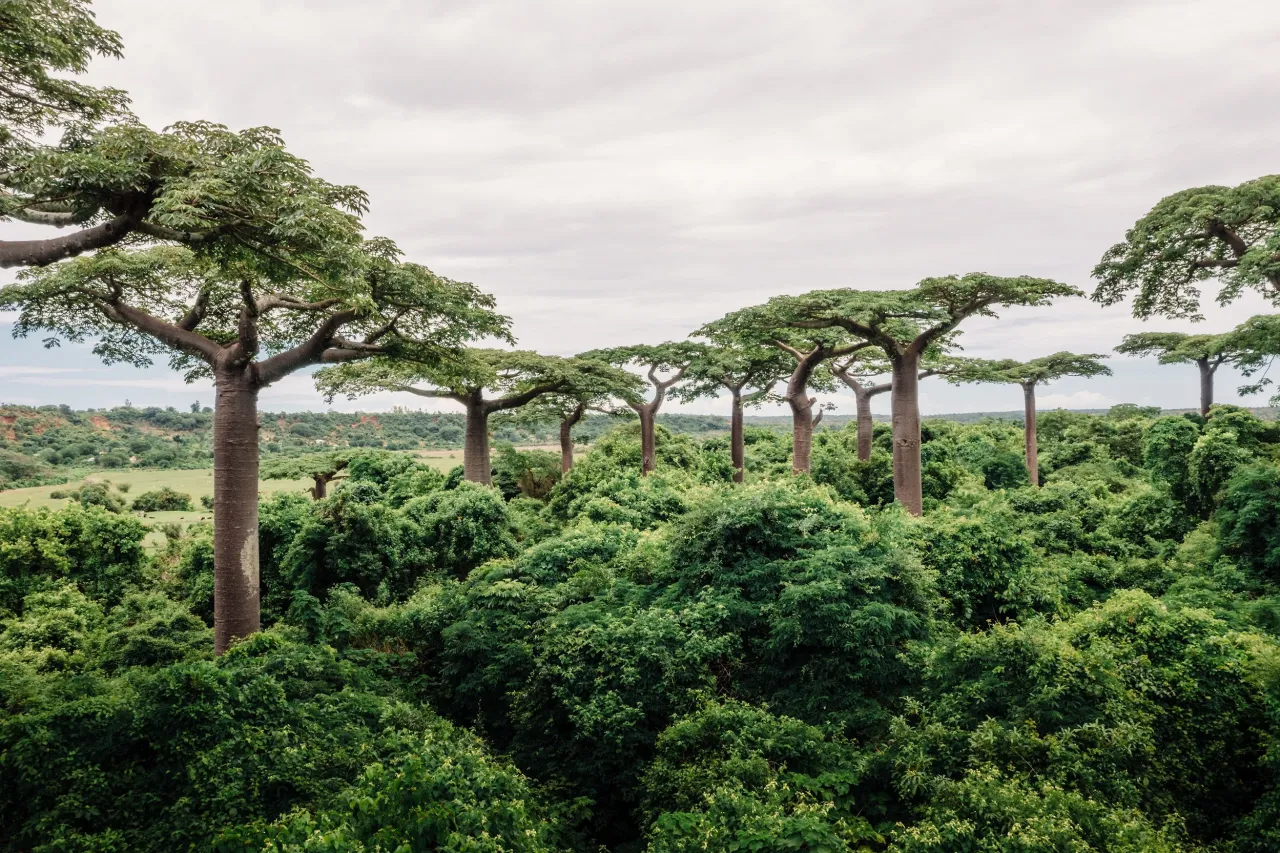
Image courtesy of Time+Tide
Politically, Madagascar is an African country – but it is not Africa; it is a world apart. Having broken away from the supercontinent Gondwana around 190-million years ago, it drifted into isolation, becoming a living laboratory for evolution.
This is not the Africa of vast savannahs and the Big Five. It is a parallel universe of nature, an “eighth continent” where over 90% of the wildlife is found nowhere else on Earth.
Your journey in Madagascar is one of constant wonder at nature’s most creative experiments. It is the land of lemurs, where more than 100 different species leap through forests, from the tiny mouse lemur to the soulful, singing indri. It is a place where chameleons the size of a thumbnail share the same land as those as large as a house cat.
The landscapes are just as unique, from the otherworldly limestone forests of stone needles known as tsingy and the iconic Avenue of the Baobabs, to the spiny deserts of the south and the verdant rainforests of the east.
This profound natural uniqueness is matched by its human story. The Malagasy people are a blend of South-east Asian and African heritage, creating a culture and language unlike any on the mainland. To travel in Madagascar is to embark on a true adventure, a challenging but deeply rewarding journey into one of the most extraordinary biodiversity hotspots on the planet.
Top travel tips for Madagascar

Did you know
Madagascar is the world’s fourth-largest island, bigger than Spain or Thailand
Plan for slow travel: Madagascar’s infrastructure is very limited, and road conditions are notoriously poor. What looks like a short distance on a map can take an entire day to travel. Be patient and build extra time into your itinerary. Domestic flights are often essential for covering large distances
Health precautions are essential: Madagascar is a high-risk malaria zone. It is vital to consult your doctor about anti-malarial medication well before your trip. You should also ensure all your routine vaccinations are up to date and drink only bottled or treated water
Carry cash: while you can use credit cards in high-end hotels in the capital, Madagascar is predominantly a cash economy. The local currency is the Malagasy ariary. You must exchange money in Antananarivo, as ATMs are unreliable or non-existent in remote areas
A local guide is non-negotiable: this is not a country for independent self-driving cars. For safety, logistics and getting the most out of your experience, hiring a reputable local guide and driver is essential. They are indispensable for navigating the roads and revealing the secrets of the parks
Learn a few basic phrases: while French is the second official language, English is not widely spoken outside of the high-end tourism sector. Learning a few words in Malagasy, such as salama (hello) and misaotra (thank you), will be hugely appreciated and open many doors
It is an experience that keeps you humble, puts things in perspective.”
